
Revisiting Christopher Nolan's masterpiece 'Interstellar' to prepare for his grand 'Odyssey'

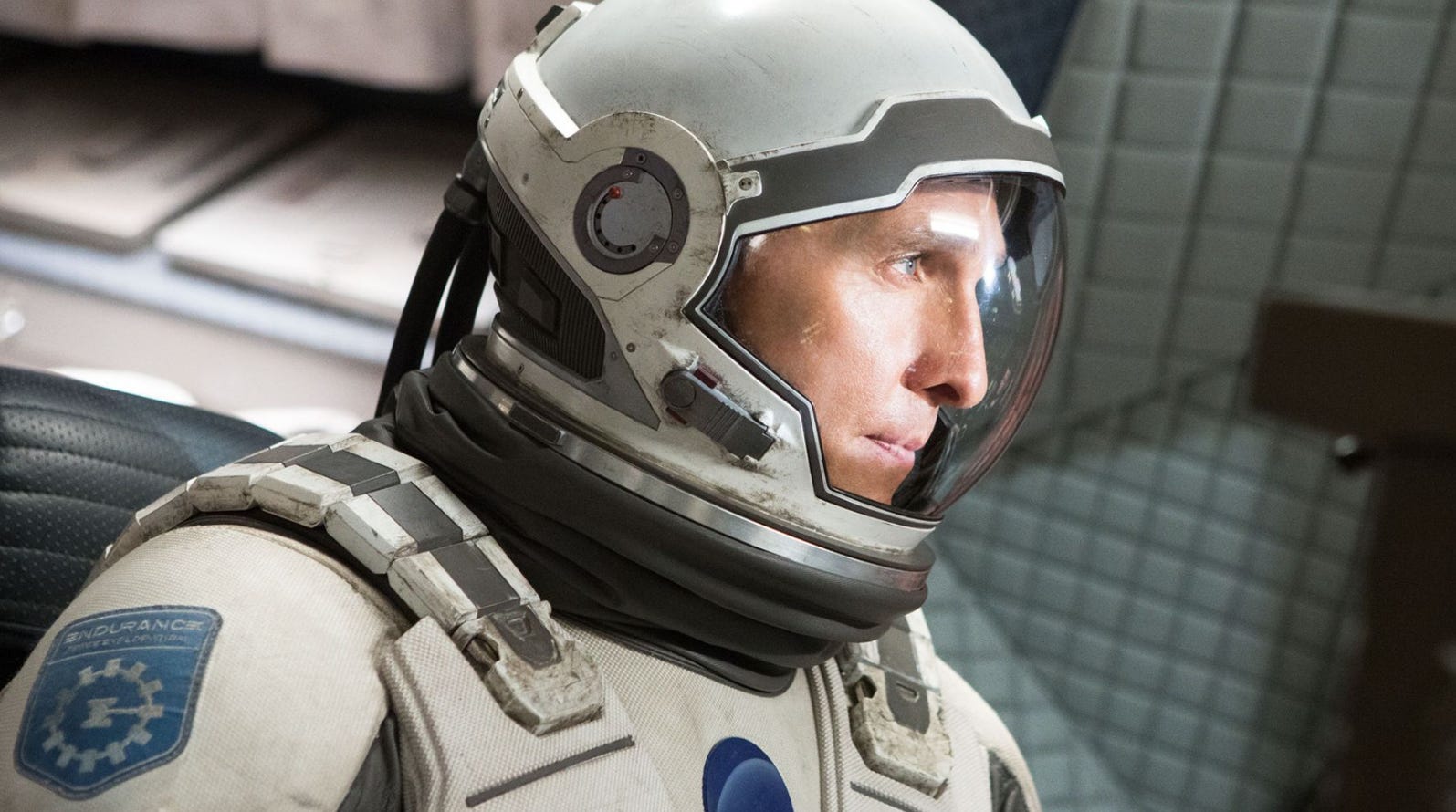
I haven’t seen director Christopher Nolan’s The Odyssey yet as of this writing, but its release on July 17 made me want to revisit his other epic about a mythic journey: 2014’s Interstellar.
Nolan is quite possibly my favorite living filmmaker. That feels like an immensely film-bro kind of thing to say, but the numbers don’t lie. Since I started compiling top 10 lists of my favorite films at the end of every year, going back to 1998, no other director has had as many titles represented:
Memento (No. 3 in 2001)
The Prestige (No. 10 in 2006)
The Dark Knight (No. 6 in 2008)
Inception (No. 4 in 2010)
Interstellar (No. 1 in 2014)
Dunkirk (No. 3 in 2017)
Oppenheimer (No. 3 in 2023)
Some of those I haven’t re-watched in quite a while, so my opinions of them might be different through 42-year-old eyes, but I’ve almost never disliked a Nolan movie. (His sole dud for me was Tenet, with which he got lost up his own posterior.) That said, Interstellar is probably my favorite film of his up to this point, his only film to top my yearly list, and my third favorite film of the entire decade. I still remember seeing it at an IMAX preview screening. I was so enthralled that I wanted to block out all other ambient voices, all other thoughts even, and just luxuriate in its celestial majesty. That night I changed my Oscar predictions and bet on it to win Best Picture.
That, um, didn’t happen. It had to settle for five nominations in below-the-line categories and a lone win for Best Visual Effects, while Nolan would end up waiting until Oppenheimer to secure his trophies for Best Picture and Best Director. At the time, I didn’t think Interstellar got the reception it deserved, scoring a respectable but unremarkable 74 on MetaCritic and 73% freshness on Rotten Tomatoes. But has my own view of it changed watching it now for the first time in years?
Well, I still think it’s a masterpiece, a gorgeous and gutsy movie that even got a seal of approval from astrophysicist Neil deGrasse Tyson for its depictions of real astronomical concepts. What struck me on this viewing was its grandeur. Most films set in space don’t fully capture the overwhelming awe of the universe, its sheer size, scope, age, and mystery. Nolan does by setting our human characters and their man-made crafts against massive objects like the planet Saturn, letting our eyes and minds try in vain to take it all in and conceptualize exactly what we’re seeing. The visual effects astonish not by being the most extensive use of CGI possible, but for creatively showcasing ideas it’s almost impossible for my limited human brain to comprehend. And Hans Zimmer’s extraordinary organ-heavy score underlines that sense of wonder.
I find that a lot of educational content about the cosmos has a similar effect on me, though, so it’s Nolan’s story that really sets Interstellar apart. It starts on a near-future Earth where a blight is destroying food crops around the world, leading to famine and disease. The human race won’t survive on the planet for much longer, so a team of NASA scientists are setting out to find a new planet for the species to inhabit. And they have help from someone or something that has placed a wormhole in our solar system to access a faraway galaxy where there are three potentially inhabitable planets orbiting a supermassive black hole called Gargantua. That black hole rivals the greatest movie monsters for abject terror.

Some of the imagery boggles the mind: a planet encased in frozen clouds, a watery planet where Gargantua’s gravity produces waves the size of mountains, and whose gravity dilates time so that 23 Earth years pass in the few hours it takes the crew to return to their ship orbiting above. What a devastating turn of events, and Nolan and his co-writer (and brother) Jonathan Nolan make excellent use of it to advance the story because Interstellar doesn’t just take place among the stars but back on Earth, where the decades pass, the peril escalates, and the characters deepen.
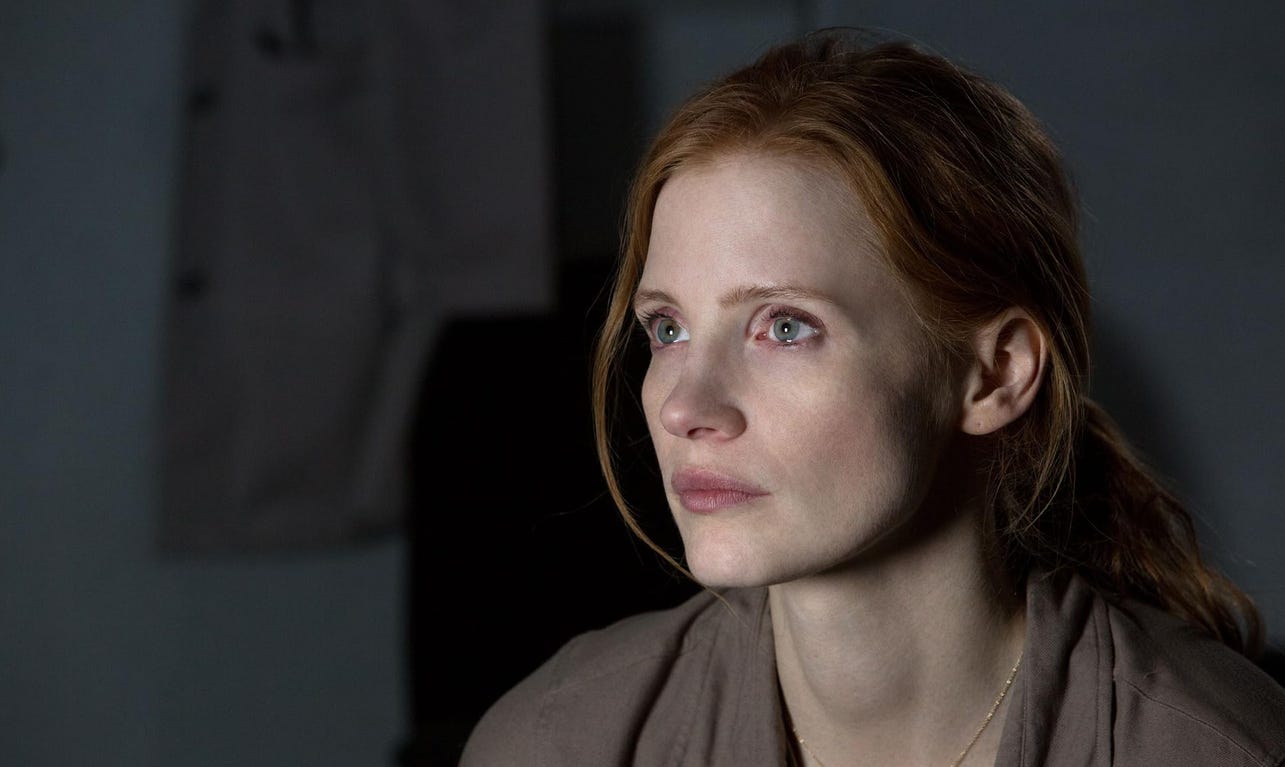
At the film’s heart is a father-daughter story. Cooper (Matthew McConaughey at the height of his McConaissance) is the best pilot for the mission through the wormhole, but that forces him to leave behind his daughter Murph (Mackenzie Foy as a child, Jessica Chastain as an adult). Coop is determined to return to his family, but Murph never stops resenting her dad for leaving. And here’s where I imagine the film loses a lot of people: Cooper literally falls into the black hole, but instead of being spaghettified, he emerges in a kind of 3D rendering of his own home through time, where he figures out how to communicate with Murph, transmits the data she needs about the black hole’s gravity, and saves the human race.
That’s a big leap to ask the audience to take. You either take that leap or you don’t, and I leapt so hard that the force might have generated its own gravitational field. There is much that the film asks us to accept without much explanation, like the math formula Murph and Professor John Brand (Michael Caine) are working on that could hold the key to transporting humans off of Earth, the data needed from the black hole, and, oh yes, how Coop survives getting sucked into the void! Nolan earns our suspension of disbelief, however, because the relationship between Coop and Murph is such a powerful motivator for both characters and because McConaughey and Chastain are so good in their roles.
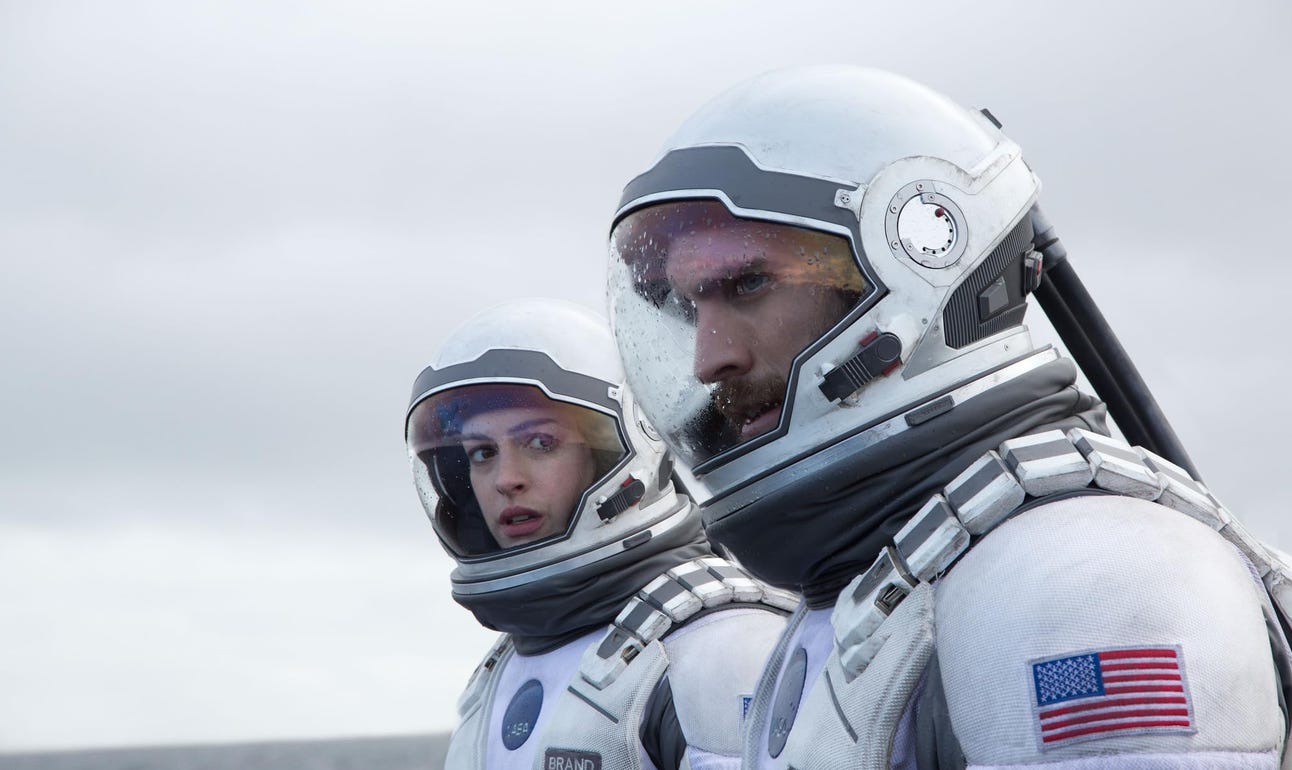
There are also some floofy bits about the power of love as a quantifiable cosmic force, put forward by Dr. Amelia Brand (Anne Hathaway), who hopes to reunite with another scientist with whom she was in a relationship. But sure, why not? I’m reminded of how Steven Spielberg’s Disclosure Day recently required me to dial down my cynicism and rewarded my openness with profound hope. Nolan does the same in Interstellar, showcasing theoretical phenomena so enormous in their scope and implications that love as a kind of intergalactic guidance system doesn’t come across as very farfetched in comparison. There are more things in heaven and Earth than are dreamt of in your philosophy. There’s more unknown out there than there is known, and science keeps searching for the many answers it doesn’t yet have. I’m left to ponder the grandness of the human race, its capacity for curiosity, imagination, adaptation, and yes, love. No matter what happens in the heavens or on Earth, we as a species are not going down without a fight. Rage, rage against the dying of the light.