
'Wicked: For Good' review: Has the musical been split in two for the better?

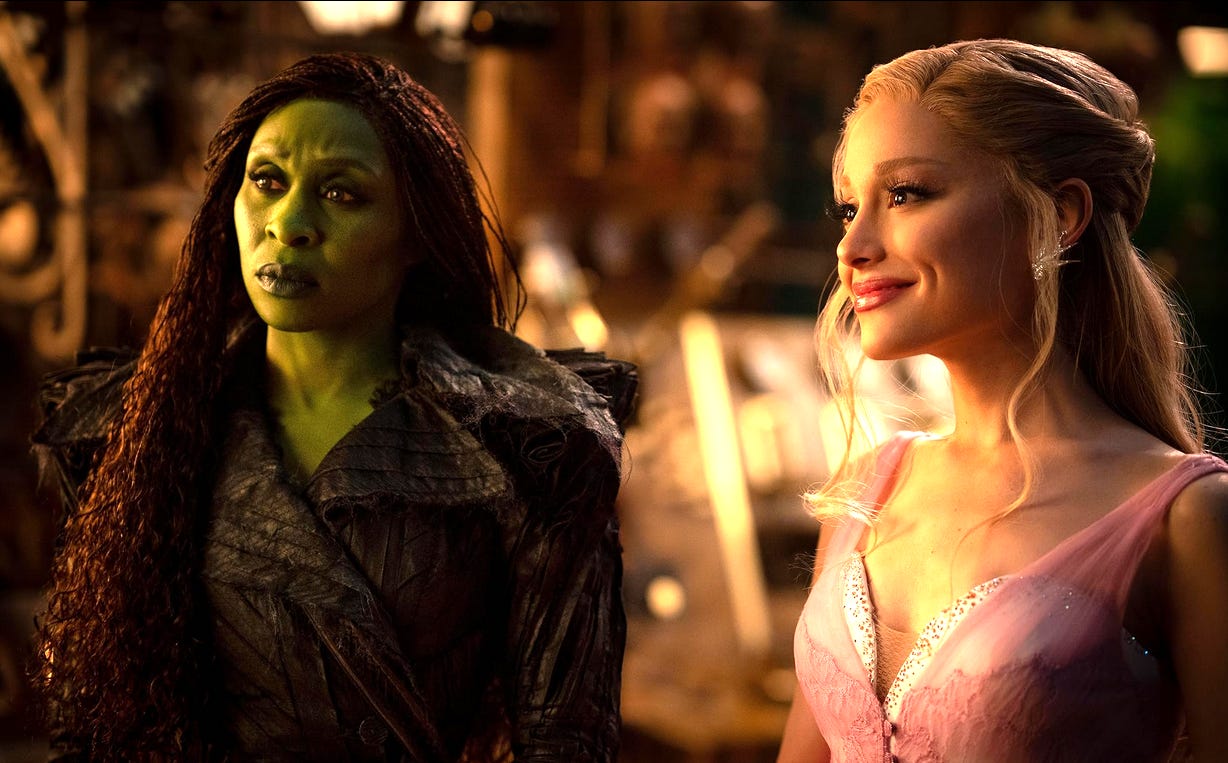
I had low expectations going into the first Wicked movie last year. I had read the novel decades earlier. I knew the general beats of the story. I had heard some of the songs. Would it really make an impact on me to hear yet another rendition of “Defying Gravity”? Well, to my surprise, the answer turned out to be yes, and director Jon M. Chu expertly milked that climactic moment for all it was worth. Wicked, it turned out, was a very good movie, and it was gratifying to see Chu achieve such a major victory after his even better musical In the Heights got lost in the haze of the COVID pandemic.
Despite all the huzzahs for the first movie, including mine, including the Motion Picture Academy’s, I went into its second part, Wicked: For Good, with similarly low expectations. First of all, it was a cynical (yet successful) cash grab to split and expand this story, which runs less than three hours on stage, to almost five hours combined. Second, I’d heard it told by many a fan of the original Broadway production that the second act is weaker than the first. The most famous songs are in part one, including “The Wizard and I,” “What Is This Feeling?,” and “Popular,” and once you’ve blown your figurative wad with “Defying Gravity,” where is there even to go?
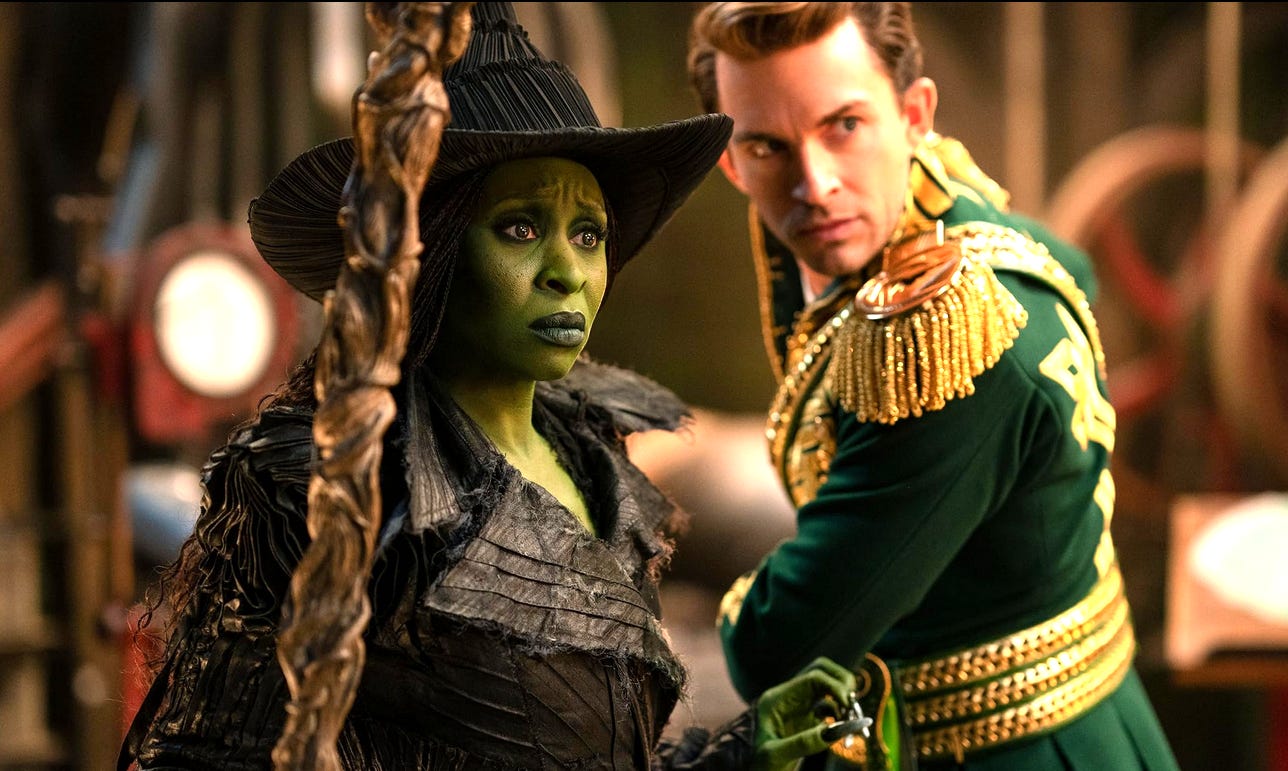
I can now report that, yes, the first half is better, but the second half isn’t half bad. Can I hum a single bar of “Thank Goodness” or “The Wicked Witch of the East” after the credits rolled? No. But while For Good’s banger-to-blah ratio isn’t as strong as its predecessor’s, it still includes high points like “No Good Deed,” the title song, and the duet “As Long as You’re Mine.” And it warms my queer little heart that “As Long as You’re Mine,” which is a thinly veiled sex scene, was performed by the openly gay “Sexiest Man Alive” (Jonathan Bailey) and an openly queer Black woman (Cynthia Erivo), to the tune of a $147 million domestic opening weekend and more than $300 million grossed worldwide after a little more than a week. Go woke or go broke, am I right?
For Good picks up where the previous film left off. Elphaba (Erivo) has learned that the Wizard of Oz (Jeff Goldblum) is a fraud. She stole his Grimmerie full of spells and set out to discredit him. Unfortunately, Madame Morrible (Michelle Yeoh) executes a successful propaganda campaign, dubbing Elphaba the Wicked Witch of the West and poisoning the public against her. Meanwhile, Glinda (Ariana Grande) is being used to pacify the masses as a spokesperson for the Wizard’s regime. Glinda and Prince Fiyero (Bailey) know what’s up, but the regime has effectively branded their former friend a villain.
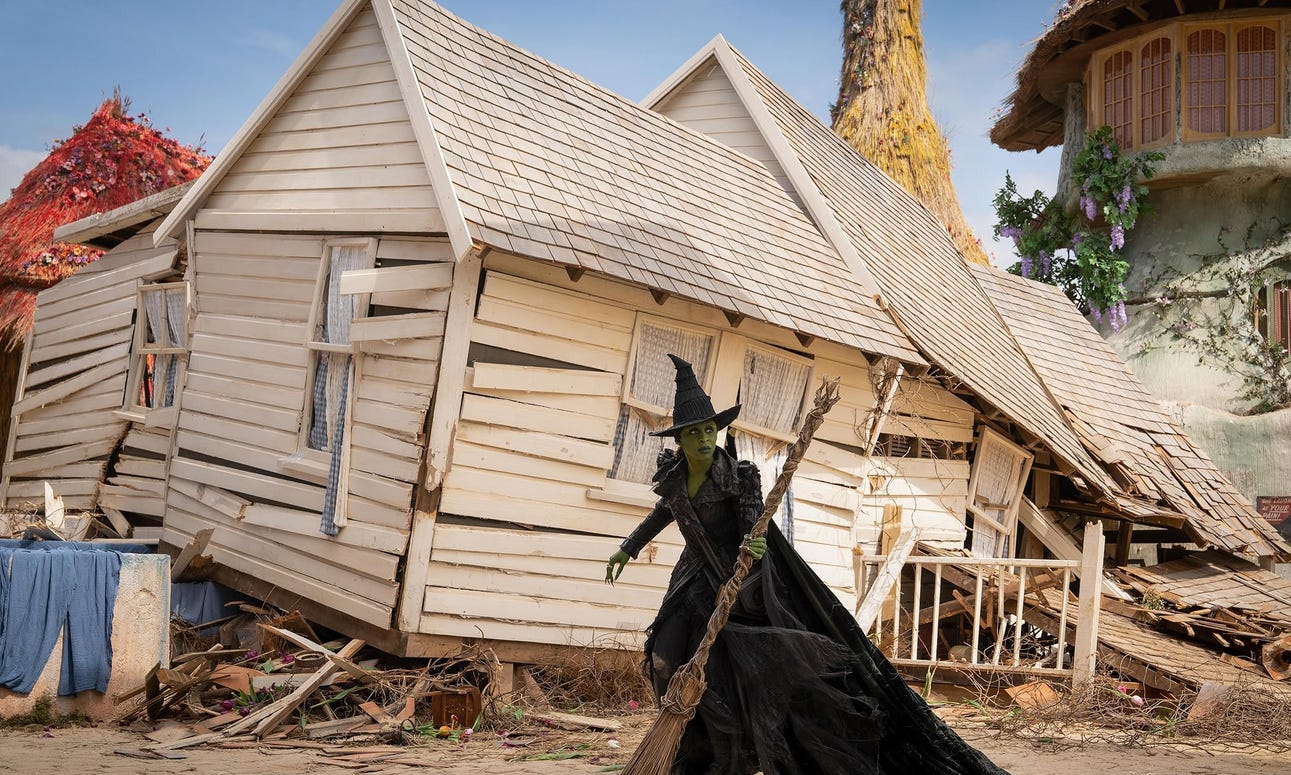
There’s a less compelling subplot about Elphaba’s sister Nessarose (Marissa Bode) and the Munchkin she loves but doesn’t love her back, Boq Woodsman (Ethan Slater). It requires an abrupt heel turn for her to become the Wicked Witch of the East, and that’s part of another problem with For Good. As the film intersects with the canonical events of The Wizard of Oz, the characters are contorted to fit their assigned purposes. Knowing what she knows, for instance, why in hell does this Glinda give Nessarose’s slippers to a complete stranger after she’s crushed by a house? How does Glinda inherit power over Oz after the Wizard finally skips town? Late in the film, Elphaba concocts a reason why Glinda shouldn’t tell anyone the truth about the so-called “Wicked” Witch, but it’s a stretch to explain why Glinda ultimately agrees to throw her former bestie under the bus. And how the flying monkeys go from the Wizard’s minions to Elphaba’s servants came off to me as vague. But the flying monkeys must come to work for Elphaba, you see, because that’s how it went in the 1939 classic film.
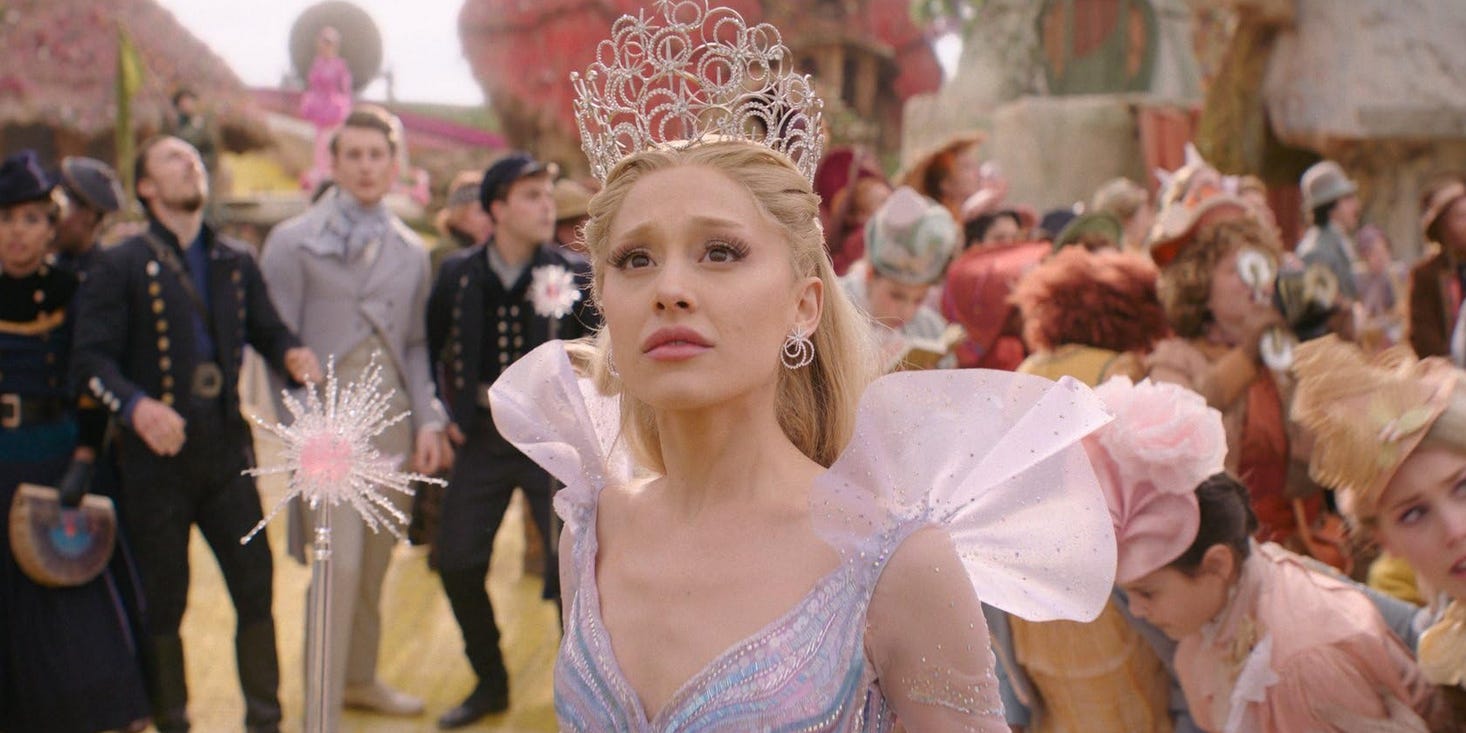
For Good is also less overtly political than the previous film, which introduced the speaking animals and the encroachment on their civil rights. That storyline made Wicked especially potent, mirroring our own world’s activist and protest movements. Part two focuses more on the love triangle between Elphaba, Fiyero, and Glinda. That’s good news for Grande especially; while the 2024 film focused on Elphaba’s personal and political awakenings, the 2025 edition gives the meaty internal conflict to Grande, and she plays it convincingly. Does Glinda give in to the comforts and privileges of being in the Wizard’s favor? Does she join Elphaba’s righteous crusade? Or can she perhaps change the system from within? She makes compromises that aren’t clean and remains morally ambiguous in a film where most of the moral lines are pretty clearly drawn.
So was it worth splitting Wicked into two films? Creatively, maybe not, though I can’t pretend it wasn’t the better financial decision judging from the record box office receipts. I imagine how one full three-hour film would have been different, how the pacing would have changed. You wouldn’t need to stretch the second act with two new, mostly unnecessary songs, “No Place Like Home” and “The Girl in the Bubble.” But would the relationships have had enough room to breathe on screen? As it is, the first Wicked seemed to me to rush through the emotional beats of Elphaba and Fiyero’s romance, and that was in a greatly expanded act one. So perhaps Wicked did need an expansion to work in cinemas. And I suppose it’s only fair to judge the bifurcation by the quality of the resulting films themselves. I’ve never seen the theatrical production, so I have nothing to compare these films to and thus don’t know if the story has been changed for the better. But it has been changed for pretty damn good.